
FAQ
What Is Shockwave Therapy?
Shockwave therapy uses acoustic pressure waves to stimulate healing in tendons and connective tissue. Learn how it works, what it treats, and what to expect.
Shockwave therapy is a non-invasive treatment that delivers targeted acoustic pressure waves into injured or chronically painful tissue. The waves stimulate circulation, break down calcifications and scar tissue, and trigger a controlled healing response, particularly effective in tendons and connective tissue that have poor blood supply and tend to heal slowly on their own.
It is most commonly used when a musculoskeletal condition has become chronic and hasn’t responded to rest, stretching, or massage alone. Most clients complete three to six sessions, spaced one week apart.
How shockwave therapy works
The acoustic waves generated during treatment create a mechanical force on the tissue they pass through. This does several things simultaneously:
Stimulates circulation. Tendons have limited blood supply, which is why tendon injuries are notoriously slow to heal. Shockwave therapy increases local blood flow, delivering the nutrients and cellular signals needed for repair.
Breaks down calcifications. In conditions like calcific shoulder tendinitis, calcium deposits form in the tendon and cause intense pain. Shockwave therapy disrupts these deposits and helps the body reabsorb them.
Disrupts scar tissue and adhesions. Chronic injuries often involve fibrotic tissue that restricts movement and perpetuates pain. The mechanical force from shockwave therapy breaks down these adhesions at a depth that manual therapy can’t reliably reach.
Triggers a healing response. In degenerated tendons, where the collagen structure has broken down from chronic overloading, the tissue essentially stops repairing itself. Shockwave therapy restarts this process by inducing a controlled inflammatory response, prompting the body to lay down new collagen.
Focused vs. radial shockwave therapy
There are two main types, and the difference matters depending on the condition being treated.
Radial shockwave therapy generates pressure waves that spread outward from the probe tip, with maximum force at the skin surface that diminishes with depth. It is suited to superficial conditions, plantar fasciitis, lateral epicondylitis (tennis elbow), and trigger points near the surface.
Focused shockwave therapy converges the waves at a specific depth within the tissue, allowing precise targeting of deeper structures. It is preferred for calcific shoulder tendinitis, deep rotator cuff pathology, and conditions requiring more concentrated energy delivery.
In practice, the type used is determined by your therapist based on the location and depth of the affected tissue. Many practitioners use both in combination within a single session.
Conditions shockwave therapy treats
Shockwave therapy has the strongest clinical evidence for tendinopathies, conditions where tendon structure has degenerated from chronic overuse. The most common indications:
Plantar fasciitis, chronic heel pain that hasn’t resolved with stretching, orthotics, or massage. One of the most evidence-supported applications.
Achilles tendinopathy, mid-tendon or insertional Achilles pain, particularly when conservative loading programs have stalled progress.
Lateral epicondylitis (tennis elbow), persistent outer elbow pain from overuse of the wrist extensors, common in office workers and trades as much as racket sports.
Medial epicondylitis (golfer’s elbow), inner elbow tendon pain from repetitive gripping or forearm work.
Calcific shoulder tendinitis, calcium deposits in the rotator cuff tendons that cause severe, often sudden shoulder pain. Shockwave is particularly effective at breaking down the calcifications.
Rotator cuff tendinopathy, chronic shoulder pain with restricted range of motion, without calcification.
Patellar tendinopathy (jumper’s knee), pain at the base of the kneecap common in runners and athletes, but also in people who spend long hours on their feet.
Chronic myofascial trigger points, persistent muscle knots in the neck, upper back, and hips that haven’t resolved with manual therapy.
What to expect during a session
Your first shockwave appointment begins with an assessment. Your therapist identifies the specific tissue involved, tests range of motion, and reviews your history before any treatment begins.
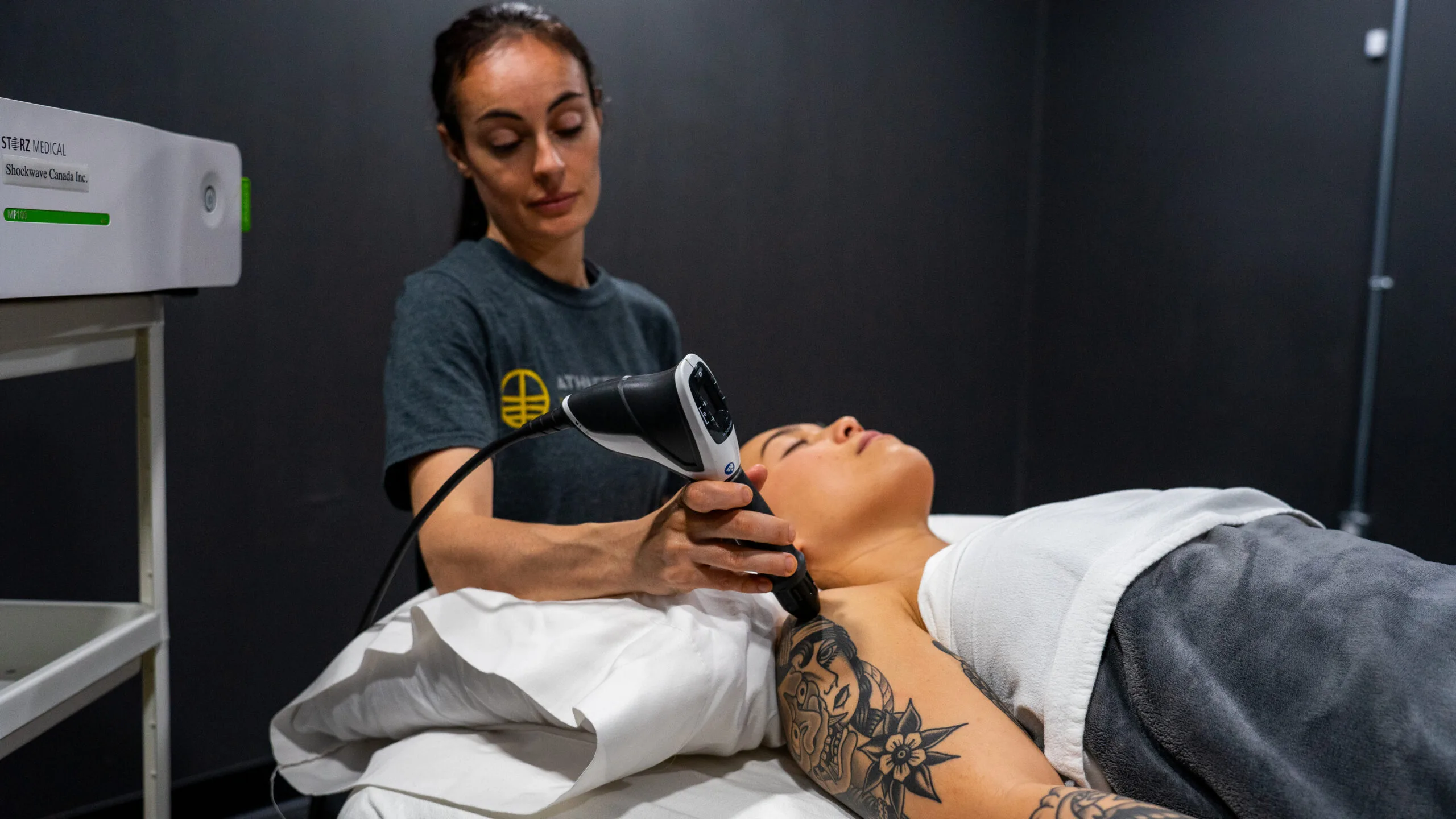
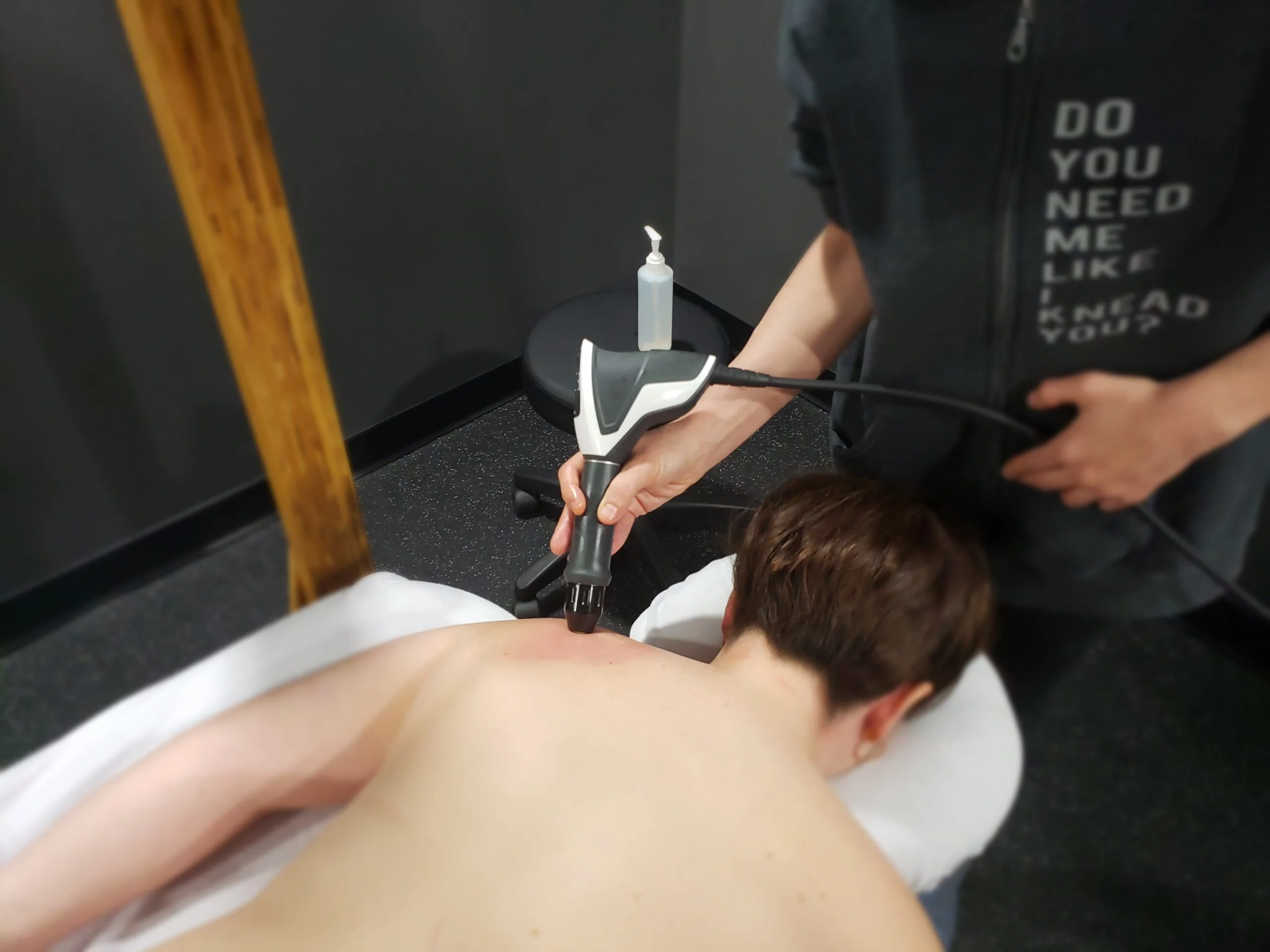
During treatment, a conductive gel is applied to the area and a handheld probe delivers the shockwaves. The sensation is a deep, repetitive pressure, most clients describe it as intense but tolerable. Your therapist adjusts the intensity in real time based on your feedback.
Sessions typically run 30 to 60 minutes, including the assessment and any complementary manual work. The shockwave application itself usually takes 10 to 20 minutes depending on the area and number of sites treated.
After treatment, mild soreness in the treated area for one to two days is normal and expected, it’s part of the healing response. Avoid anti-inflammatory medications in the 24 to 48 hours before and after treatment, as they can blunt the inflammatory response the therapy is designed to trigger.
How many sessions does shockwave therapy take?
Most conditions respond within three to six sessions, spaced approximately one week apart. Some clients notice improvement after the first or second session; others see the full benefit after completing the series.
Factors that influence how many sessions you need:
- How long the condition has been present, chronic presentations (12+ months) typically take longer than recent-onset ones
- The specific tissue involved, calcific deposits often respond in fewer sessions than degenerative tendinopathy
- Whether you’re completing the recommended home care between sessions (loading exercises, activity modification)
Your therapist will give a specific recommendation after your first assessment.
Is shockwave therapy effective?
For its primary indications, plantar fasciitis, Achilles tendinopathy, tennis elbow, calcific shoulder, and rotator cuff tendinopathy, shockwave therapy has a well-established evidence base. A commonly referenced study of 384 patients with various tendinopathies found significant reductions in pain and improvements in function that were sustained at four-week follow-up.
It is not effective for every condition. Acute injuries, fractures, and presentations with active inflammation are not appropriate for shockwave therapy. Your therapist will assess at your first visit whether shockwave is the right treatment for your specific situation.
Side effects
Shockwave therapy is generally well tolerated. The most common side effects are:
- Temporary soreness or tenderness in the treated area for one to two days
- Mild redness or skin irritation at the treatment site
- Occasional bruising, particularly in sensitive areas
Serious adverse events are rare. The treatment is contraindicated for pregnant clients, those with active cancer in or near the treatment area, clients with pacemakers, and areas with open wounds or fractures.
Shockwave therapy in Edmonton and Sherwood Park
Shockwave therapy is available at Athlete’s Choice Massage across all four Edmonton-area clinics, West Edmonton, Downtown Edmonton, South Edmonton, and Sherwood Park.
- Shockwave therapy Edmonton, all three Edmonton clinics, direct billing available
- Shockwave therapy Sherwood Park, Broadmoor Blvd, Emerald Hills area, direct billing available
Book online or call 780-433-0550.
Shockwave is one of many treatments at our massage clinics in Edmonton, book online or call 780-433-0550.
Related Treatments & Conditions