
FAQ
What Does Reflexology Feel Like, and Does It Actually Work?
What reflexology feels like, what the evidence actually shows, and its real side effects. An honest guide from Edmonton's locally-owned RMT clinic.
What does reflexology feel like?
Mostly relaxing, with brief moments of intensity at specific points.
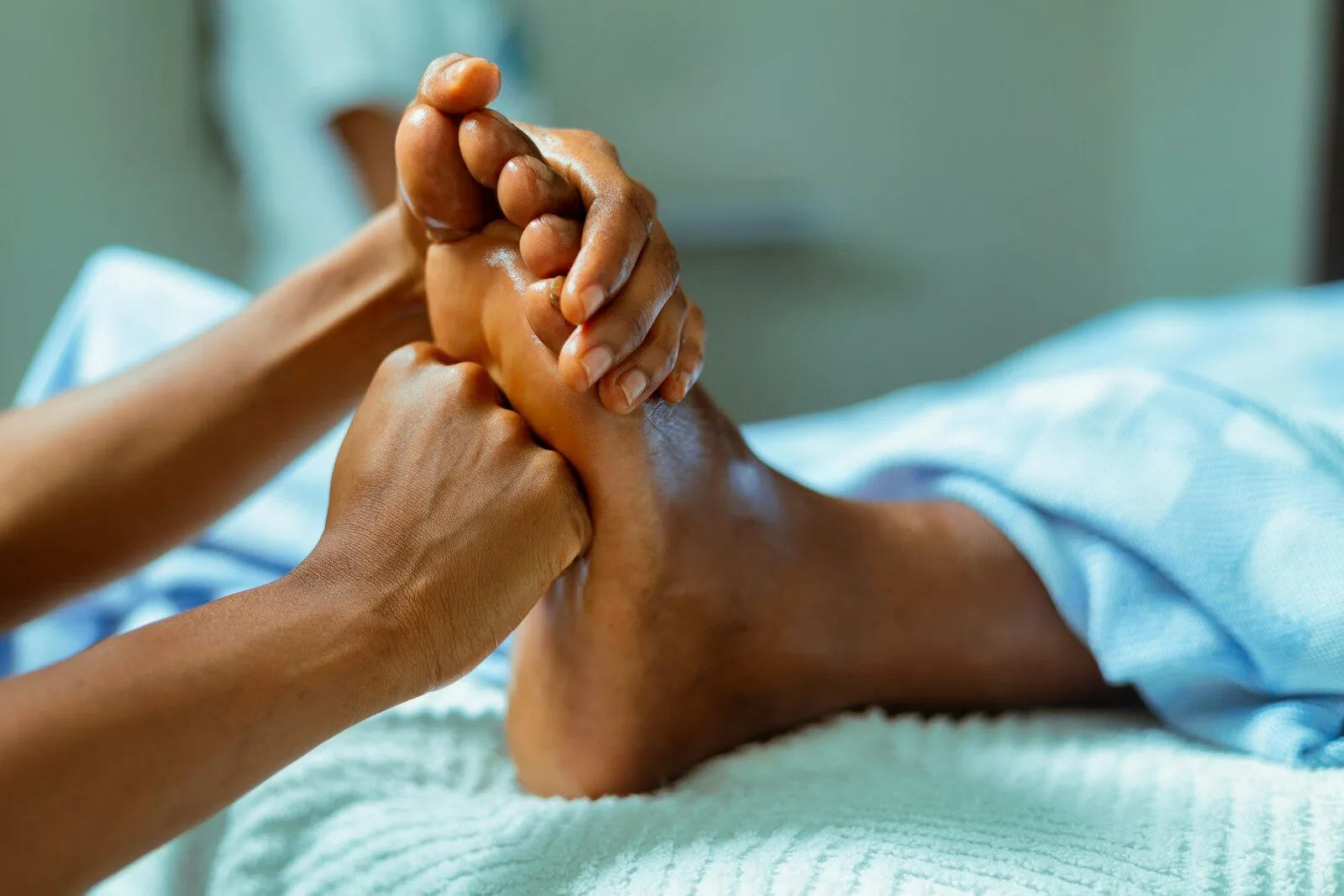
The therapist works through your feet in a structured sequence. You feel sustained thumb-and-finger pressure on individual points, sometimes circular movement, occasionally a stretch through the toes and ankles. Depth varies point to point. Some areas you barely notice. Others register as a sharp-ish “good pain” that fades within a few seconds.
You stay awake, though plenty of clients drift into a near-sleep state. No oil is used and you stay clothed apart from shoes and socks. Sessions run 45 or 60 minutes.
If something genuinely hurts, say so. Tenderness that fades in seconds is normal. Sharp or lasting pain is not, and your therapist will adjust pressure straight away.
Why do my feet itch or tingle afterwards?
Because local circulation to the feet increases during a session, and that sensation usually passes within a few hours.
Warmth, tingling, mild itching and a need to use the bathroom are all commonly reported. Cancer Research UK lists lightheadedness, tender feet, an emotional response and increased urination among the usual after-effects. None of them are a cause for concern on their own.
What is reflexology, exactly?
Reflexology is a focused-pressure technique applied to the feet, and sometimes the hands or ears.
The working idea is that mapped points on the feet correspond to organs and systems elsewhere in the body. Pressure on those points is intended to reduce tension and prompt the nervous system to settle. You will also see it called zone therapy or foot reflexology.
It is not a foot massage, and the difference is not marketing:
| Reflexology | Therapeutic foot massage | |
|---|---|---|
| What’s worked | Mapped points on the feet | Muscles and fascia of the feet |
| Pressure | Sustained, point-specific | Broader, sweeping |
| Position | Reclined, fully clothed | On a table, draped |
| Goal | A systemic, whole-body response | Local relief in the foot itself |
| Best for | Stress, sleep, complementary care | Plantar pain, arch tightness, recovery |
Does reflexology actually work?
For relaxation, anxiety and sleep the evidence is genuinely encouraging. For treating a medical condition, it is not.
Taking those in order, because the honest answer is split:
- Anxiety and sleep. A 2020 meta-analysis of 26 randomized trials covering 2,366 adults found large improvements in anxiety, sleep quality and depression scores after foot reflexology. The authors flag real limitations: blinding is close to impossible, only one trial managed it, and heterogeneity between studies was very high.
- Medical conditions. A systematic review of 18 randomized trials found 5 positive results against 12 showing no effect. Its conclusion was that the best evidence “did not convincingly demonstrate that reflexology was an effective treatment for any medical condition.”
- Cancer care. A 2024 review of reflexology in oncology reached no clear verdict, citing heterogeneous results and methodological limits across the studies it examined.
The fair reading: reflexology is a well-tolerated way to downregulate stress. It is not a treatment for disease. Cancer Research UK puts that plainly. There is “no scientific evidence to prove that reflexology can cure or prevent any type of disease.”
Anyone selling it to you as more than that is overselling it. If you are curious, book one 60-minute session and judge how you feel over the following two days. That is a fairer test than reading abstracts.
Is the “detox” reaction real?
No. Headaches, nausea or fatigue after a session are not your body releasing toxins, because that is not a mechanism anyone has demonstrated.
You will see the detox explanation on a lot of clinic websites. It has no evidential basis, and we are not going to repeat it to you. What is well documented is the ordinary after-effect list above: lightheadedness, tender feet, sometimes an emotional response.
If you feel genuinely unwell after a session, that is worth mentioning to your therapist and, if it persists, to your doctor. It is not a sign the treatment is working.
Can reflexology help with migraines?
It will not stop a migraine already underway, and no reflexologist should tell you otherwise.
Where clients more often report a difference is in frequency over a course of sessions rather than in aborting an attack. That is an observation from practice, not a proven effect, and it sits inside the mixed evidence described above.
Sessions for migraine-prone clients typically spend extra time on:
- The big toe and its neighbours, mapped to the head, neck and brain
- The base-of-neck reflex, at the bottom of the toe joints
- The solar plexus reflex, in the central arch
- The spine reflex, along the inside arch of the foot
Track your migraine days before and during a four to six session course. If nothing moves, stop. For a treatment approach aimed directly at the muscles involved, see massage for headaches and migraines in Edmonton.
Can reflexology help you sleep?
This is the strongest thing the research says about it.
Sleep quality showed the largest improvement of the three outcomes in the 2020 meta-analysis. The authors also found that longer total reflexology time predicted bigger gains. The same caveats apply, so treat it as promising rather than settled.
It also works alongside the basics rather than instead of them. The NHS guidance on insomnia covers the sleep-schedule and environment changes that do the heavy lifting.
Who should avoid reflexology?
Anyone with a foot problem that pressure could make worse, and anyone whose doctor has told them to protect their circulation.
Check with your physician first if you have:
- Circulatory problems in the feet, or blood clots or inflammation in the leg veins
- An open wound, ulcer, fungal infection or active rash on the foot
- Gout, or a low platelet count
- Recent foot surgery
Those categories follow Cancer Research UK’s guidance on who should speak to a doctor before booking. Postpone if you are acutely unwell or contagious. If you are pregnant, talk to your care provider first, and consider prenatal massage in Edmonton as the better-established option.
Tell your therapist about medical conditions, medications and recent surgeries when you book. They will adjust or point you at a different treatment if that serves you better.
Is reflexology covered by benefits in Alberta?
Usually, when a Registered Massage Therapist performs it and your plan includes a massage therapy benefit.
Coverage varies by insurer and by plan, so check yours before assuming. Our direct billing page lists the providers we bill on your behalf.
How do you book reflexology in Edmonton?
Athlete’s Choice Massage offers reflexology across our four clinics, as a standalone session or added to a regular appointment.
Sessions are 45 or 60 minutes, every visit is booked in advance, and same-day appointments are often available. Full details and online booking are on the reflexology service page.
If your goal is muscular pain or recovery rather than stress, therapeutic massage is the better starting point. Plenty of clients alternate between the two.
Related Treatments & Conditions