
Conditions We Treat
Plantar Fasciitis Treatment in Sherwood Park
Book NowPlantar fasciitis treatment in Sherwood Park, shockwave therapy plus targeted RMT massage for chronic heel pain. Direct billing. Book online.
That sharp heel pain with your first steps of the morning, plantar fasciitis is one of the most common and persistent foot conditions we treat. For chronic cases, shockwave therapy is our main treatment, supported by targeted massage and a home-care plan that addresses the calf tightness driving the problem. If you’re looking for plantar fasciitis treatment in Sherwood Park, here’s how it works and how to book at our Broadmoor Blvd location in Strathcona County.
When heel pain needs urgent care first
Heel and foot pain is almost always mechanical in origin, but a few presentations warrant a medical assessment before massage. If your heel pain is accompanied by significant swelling, bruising, or the inability to bear weight after an acute injury, rule out a stress fracture or tendon rupture with your physician first. Sudden severe calf pain with swelling, particularly after travel or prolonged immobility, should be assessed promptly to rule out a deep vein thrombosis before any soft tissue work is done.
For the far more common presentation of chronic morning heel pain that eases with walking, massage is appropriate and effective.
What is plantar fasciitis?
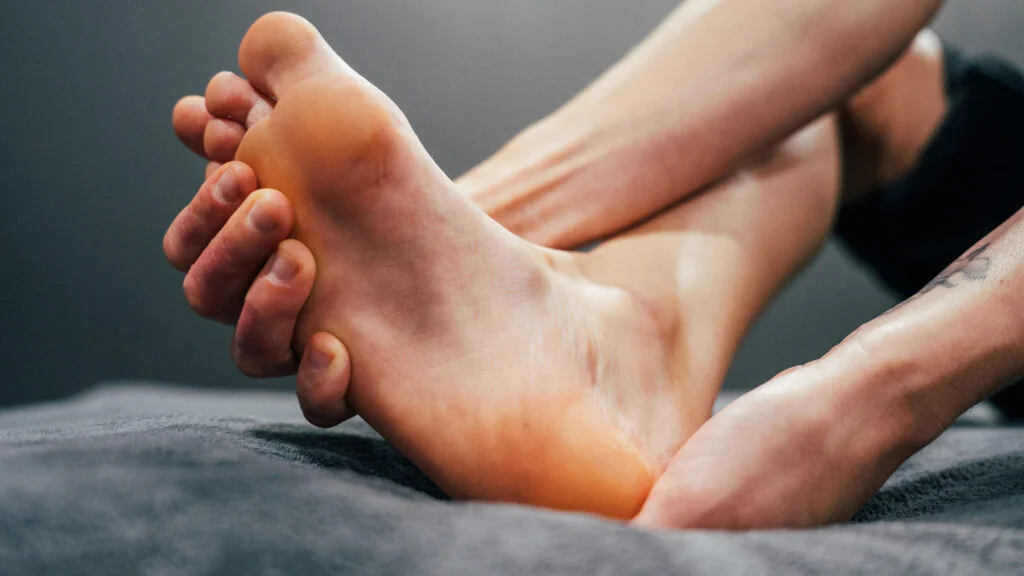
The plantar fascia is a thick band of connective tissue running along the bottom of your foot, connecting the heel bone (calcaneus) to the base of the toes. Plantar fasciitis is inflammation and microtearing of this tissue, most commonly at its calcaneal insertion. The hallmark symptom is sharp heel pain with the first steps after rest: out of bed in the morning, or standing up after sitting for an extended period. The pain typically eases after a few minutes of walking as the tissue warms up, but returns after prolonged activity or at the end of a long day on your feet.
It’s most common in runners, people who stand for long hours on hard surfaces, and those who’ve recently increased activity load. Tight calf muscles and a restricted Achilles tendon are a major contributing factor, when the calf complex is shortened, it increases tensile load on the plantar fascia with every step. Weakness in the intrinsic foot muscles and poor arch support compound the problem over time.
Shockwave therapy: our main treatment for plantar fasciitis
For plantar fasciitis, especially chronic cases that haven’t responded to stretching, orthotics, or hands-on care, shockwave therapy is our primary treatment, and it’s available at our Sherwood Park clinic. It’s one of the most evidence-supported options for the condition: focused acoustic waves stimulate a fresh healing response in tissue that has stopped repairing on its own, directly at the plantar fascia and its attachment at the heel.
Most clients complete three to six shockwave sessions spaced about a week apart, combined with the calf and foot work below. Book shockwave therapy for plantar fasciitis →
How massage supports your treatment
The most important thing to understand about plantar fasciitis massage: effective treatment isn’t just about working the sore heel. The gastrocnemius, soleus, and Achilles all transmit load directly to the plantar fascia. Treatment that targets only the bottom of the foot gets limited results because it leaves the primary driver, calf restriction, unaddressed.
Our RMTs work across the full kinetic chain:
- Deep tissue work on the gastrocnemius and soleus (the calf complex) to reduce the tension pulling on the calcaneal attachment
- Achilles and plantar fascia release to address the fascial tissue directly
- Intrinsic foot work, the small muscles supporting the medial arch that offload the fascia when functioning well
- Assessment of contributing factors up the chain (hip flexors, hamstrings) where indicated
Massage and shockwave therapy are frequently combined for plantar fasciitis, the shockwave drives the tissue-level healing while hands-on work releases the calf restriction loading the fascia, especially for cases present for three months or more.
Self-care between sessions
Rolling the plantar fascia with a tennis ball helps sustain your treatment gains between sessions, but technique and dosage matter, and overdoing it can set your recovery back. We’ve put the full protocol in one place: how long to roll, how much pressure to use, what to do when it hurts more instead of less, and the calf stretches that should go with it. See our plantar fasciitis self-massage guide for the step-by-step, and your RMT will fine-tune it for your foot at your first session.
What to expect at Athlete’s Choice Sherwood Park
Athlete’s Choice Massage, Sherwood Park is located at 2457 Broadmoor Blvd #114, near Millennium Place in Strathcona County. Our RMTs at this location are experienced in lower limb conditions and work regularly with plantar fasciitis presentations ranging from recent-onset to long-standing chronic cases.
At your first visit, your therapist will assess the foot and lower leg, checking calf mobility, Achilles flexibility, and the specific location and quality of your heel pain. The treatment sequence follows the kinetic chain: calf and Achilles work comes first to address the upstream restriction, then direct plantar fascia work once the tissue above is released. You’ll leave with a home-care plan including the rolling protocol and calf stretching sequence appropriate for your presentation.
Sessions typically run 45–60 minutes. Most clients notice improvement within 2–3 sessions. For long-standing plantar fasciitis (6 months or more), more sessions are typically needed before the pattern breaks. Your RMT will give a specific recommendation after your first-session assessment.
Book plantar fasciitis massage in Sherwood Park
Athlete’s Choice Massage, Sherwood Park is at 2457 Broadmoor Blvd #114, Sherwood Park, AB T8H 1N1. Phone: 780-433-0550. Direct billing is available to most major insurance providers, we bill your insurer directly so you don’t pay out of pocket and submit a claim yourself.
→ Book plantar fasciitis massage at Sherwood Park
Athlete’s Choice also offers plantar fasciitis treatment at three Edmonton locations:
- West Edmonton, Near West Edmonton Mall and Stony Plain Road, Book online
- South Edmonton, on 67 Ave NW, Book online
- Downtown Edmonton, Central business district, Book online
Frequently asked questions
How long does plantar fasciitis take to resolve?
With consistent treatment and home care, most plantar fasciitis cases improve meaningfully within 6–12 weeks. Cases present for over a year can take longer. The key variable is addressing the calf restriction driving the load on the fascia, not just treating the heel in isolation. Long-standing cases may also benefit from shockwave therapy in combination with massage to break the chronic irritation cycle.
Should I rest completely if I have plantar fasciitis?
Complete rest isn’t recommended and often makes things worse. Low-impact movement, cycling, swimming, walking on even surfaces, that doesn’t repeatedly load the heel maintains circulation and tissue health without aggravating the fascia. Reducing high-impact activity (running, court sports, jumping) while the tissue heals is appropriate. Full rest tends to weaken the intrinsic foot muscles that support the arch and actually prolongs recovery.
Is plantar fasciitis massage covered by insurance in Alberta?
Yes, massage therapy is covered under most Alberta extended health benefit plans. Athlete’s Choice offers direct billing at our Sherwood Park location, so your insurer is billed directly without you having to pay out of pocket and submit a claim.
What is shockwave therapy and how does it help plantar fasciitis?
Shockwave therapy uses focused acoustic pressure waves to stimulate healing in chronically irritated connective tissue. For plantar fasciitis that has been present for 3 months or more, shockwave has strong clinical evidence as an effective intervention. It works by breaking down scar tissue at the calcaneal insertion and triggering a fresh healing response in tissue that has essentially stopped remodelling. Athlete’s Choice Sherwood Park offers shockwave therapy and commonly combines it with massage for chronic plantar fasciitis cases.
Can massage help if I’ve had plantar fasciitis for years?
Yes, though chronic cases take longer to respond. Long-standing plantar fasciitis typically involves both fascial thickening at the calcaneal attachment and significant cumulative calf restriction. The treatment approach is the same, work up the kinetic chain, address the calf and Achilles before the plantar surface, but more sessions are needed before the pattern breaks. Adding shockwave to the protocol is often the most effective strategy for cases that haven’t responded to massage alone.
Related Treatments & Conditions